

Exercise for Muscle Growth: Science-Based Training Guide

Building muscle requires more than showing up to the gym and lifting weights randomly. The science of hypertrophy reveals that strategic exercise for muscle growth depends on understanding how mechanical tension, metabolic stress, and muscle damage interact to trigger adaptation. Whether you're new to resistance training or looking to optimize your current program, evidence-based principles can help you maximize gains while minimizing wasted effort and injury risk.
The Physiology Behind Muscle Hypertrophy
When you perform resistance exercise, you create microscopic damage to muscle fibers. This controlled stress signals your body to repair and reinforce those fibers, making them larger and stronger. The process involves complex molecular pathways, particularly the mTOR signaling cascade that regulates muscle protein synthesis.
Understanding these mechanisms helps explain why certain training variables matter more than others. Three primary stimuli drive muscle growth:
- Mechanical tension from lifting challenging loads through a full range of motion
- Metabolic stress created by sustained muscle contractions and incomplete recovery between sets
- Muscle damage that triggers inflammatory responses and satellite cell activation
The balance between muscle protein synthesis and muscle protein breakdown determines net growth. Training stimulates synthesis, while proper nutrition and recovery prevent excessive breakdown. Research published in Nature Communications explores how muscle tissue responds to training stress at the cellular level, providing insight into why consistency and progressive challenge are non-negotiable.

Progressive Overload: The Foundation of Muscle Growth
No principle matters more for exercise for muscle growth than progressive overload. Your muscles adapt to the specific demands you place on them, so maintaining the same workout indefinitely yields diminishing returns. Progressive overload means systematically increasing training stress over time.
Practical Methods to Implement Progressive Overload
| Method | Application | Example |
|---|---|---|
| Increase weight | Add 2.5-5 lbs when you can complete target reps | Bench press: 135 lbs × 8 → 140 lbs × 8 |
| Add repetitions | Perform more reps with the same weight | Squats: 185 lbs × 6 → 185 lbs × 8 |
| Increase volume | Add sets or exercises | 3 sets → 4 sets per muscle group |
| Enhance technique | Slow eccentrics, pause reps, fuller range | 2-second eccentric → 4-second eccentric |
| Reduce rest periods | Maintain performance with less recovery | 90-second rest → 60-second rest |
The American College of Sports Medicine's resistance training guidelines emphasize that beginners can progress rapidly, while advanced lifters need more sophisticated programming. Most individuals should aim to increase training stimulus every 1-3 weeks, though the specific timeline depends on recovery capacity and training age.
Training logs are essential. Without tracking your workouts, you cannot accurately apply progressive overload. Record exercises, weights, sets, reps, and subjective difficulty. This data reveals patterns and ensures you're consistently challenging your muscles rather than simply repeating familiar movements.
Optimal Training Variables for Hypertrophy
Exercise selection, volume, intensity, and frequency all influence muscle growth outcomes. While individual responses vary, research provides clear guidelines for structuring effective programs.
Exercise Selection and Movement Patterns
Compound exercises that involve multiple joints and large muscle groups should form your program's foundation. Squats, deadlifts, presses, and rows recruit more total muscle mass and allow heavier loading than isolation movements. However, single-joint exercises play an important supporting role by targeting specific muscles that may be underdeveloped.
A balanced program includes:
- Horizontal pushing (bench press, push-ups)
- Vertical pushing (overhead press, dips)
- Horizontal pulling (rows, inverted rows)
- Vertical pulling (pull-ups, lat pulldowns)
- Knee-dominant lower body (squats, leg press)
- Hip-dominant lower body (deadlifts, Romanian deadlifts)
- Isolation work for arms, shoulders, calves, and core
Consider investing in home fitness strength equipment that supports these fundamental movement patterns, allowing consistent training regardless of gym access.
Volume, Intensity, and Frequency
Training volume represents the total amount of work performed, typically measured as sets per muscle group per week. Current evidence suggests:
- Beginners: 10-12 sets per muscle group weekly
- Intermediate: 12-18 sets per muscle group weekly
- Advanced: 18-25+ sets per muscle group weekly
Intensity refers to the load lifted relative to your one-repetition maximum (1RM). For muscle growth, working with 60-85% of 1RM is most effective. Practically, this means training within 2-3 reps of failure on most sets. The relationship between reps and percentage of 1RM approximately follows this pattern:
| Rep Range | % of 1RM | Primary Benefit |
|---|---|---|
| 1-5 reps | 85-100% | Strength, neural adaptation |
| 6-12 reps | 70-85% | Hypertrophy, strength |
| 12-20 reps | 60-70% | Hypertrophy, endurance |
| 20+ reps | <60% | Endurance, work capacity |
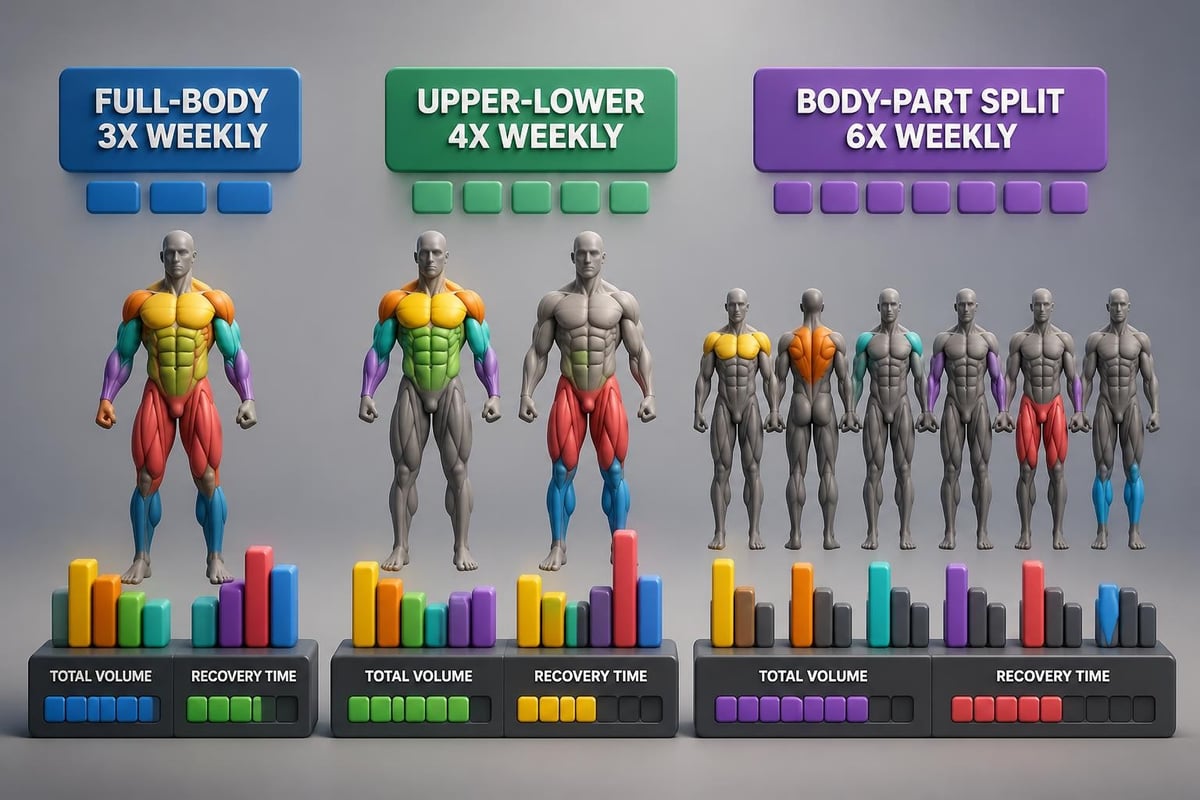
Training frequency describes how often you train each muscle group weekly. Most people achieve optimal results training each muscle 2-3 times per week, allowing 48-72 hours between sessions for the same muscle group. This approach provides multiple growth stimuli while permitting adequate recovery.
Recovery: The Overlooked Growth Factor
Muscle doesn't grow during training; it grows during recovery. Exercise for muscle growth creates the stimulus, but adaptation occurs when you rest. Many dedicated lifters under-recover, inadvertently limiting their progress despite intense effort in the gym.
Sleep represents the most critical recovery tool. During deep sleep, growth hormone secretion peaks, and muscle protein synthesis accelerates. Research consistently shows that insufficient sleep (less than 7 hours nightly) impairs muscle recovery, reduces training performance, and compromises body composition. For detailed guidance, explore the science of accelerated recovery.
Active Recovery Strategies
Between heavy training sessions, active recovery can enhance adaptation without creating excessive fatigue:
- Light cardiovascular activity (walking, cycling) to promote blood flow
- Mobility work and stretching to maintain range of motion
- Foam rolling or percussion therapy to address muscle tightness
- Low-intensity movement patterns from your training (unloaded squats, arm circles)
Understanding why recovery matters as much as your workout helps you view rest days as productive components of your program rather than time off. Quality recovery and muscle care tools can accelerate the adaptation process and prepare you for your next training session.
Nutrition: Fueling Muscle Protein Synthesis
Training provides the stimulus for growth, but nutrition supplies the raw materials. Without adequate protein, energy, and micronutrients, your body cannot build new muscle tissue efficiently.
Protein intake is paramount. Current evidence suggests consuming 1.6-2.2 grams of protein per kilogram of body weight daily for individuals engaged in regular resistance training. For a 180-pound (82 kg) person, this translates to approximately 130-180 grams daily.
Protein quality and timing both matter, though consistency over the long term matters most. Research on whey protein supplementation and muscle protein synthesis demonstrates that rapidly-digested proteins containing adequate leucine effectively stimulate growth when consumed around training sessions.
Practical Protein Distribution
| Meal Timing | Protein Target | Example Sources |
|---|---|---|
| Breakfast | 25-40g | Eggs, Greek yogurt, protein shake |
| Mid-morning | 20-30g | Cottage cheese, protein bar, nuts |
| Lunch | 30-45g | Chicken breast, fish, lean beef |
| Pre-workout | 20-30g | Whey protein, turkey, tuna |
| Post-workout | 25-40g | Protein shake, salmon, tofu |
| Dinner | 30-45g | Steak, pork, tempeh |
Total daily calories also influence muscle growth. Building tissue requires energy surplus, though the surplus needn't be excessive. A modest 200-400 calorie surplus above maintenance supports muscle growth while minimizing fat gain. Carbohydrates fuel intense training sessions and replenish muscle glycogen, while fats support hormone production and overall health.
Periodization and Long-Term Programming
Effective exercise for muscle growth programs incorporate planned variation to prevent plateaus and manage fatigue. Periodization refers to the systematic cycling of training variables over weeks and months.
Linear Periodization
This traditional approach gradually increases intensity while decreasing volume. A 12-week cycle might progress as follows:
- Weeks 1-4: Higher volume (4-5 sets × 12-15 reps) at moderate intensity
- Weeks 5-8: Moderate volume (3-4 sets × 8-10 reps) at higher intensity
- Weeks 9-11: Lower volume (2-3 sets × 4-6 reps) at peak intensity
- Week 12: Deload with reduced volume and intensity
Linear periodization works well for beginners and during specific preparation phases, though intermediate and advanced lifters often benefit from more complex models.
Undulating Periodization
This approach varies intensity and volume more frequently, sometimes within the same week or even the same workout. Daily undulating periodization might structure training as:
- Monday: Heavy day (3-4 sets × 4-6 reps)
- Wednesday: Moderate day (3-4 sets × 8-10 reps)
- Friday: Light day (2-3 sets × 12-15 reps)
This variation prevents repetitive strain, addresses multiple adaptations simultaneously, and often suits intermediate lifters well. Learn more about structuring sustainable programs in the flex routine: why consistency beats intensity.
Common Training Mistakes That Limit Growth
Even dedicated individuals often make preventable errors that compromise results. Recognizing these pitfalls helps you train smarter:
Chasing too much variety. While exercise variation prevents boredom, constantly changing your program prevents progressive overload. Master fundamental movements before adding exotic variations.
Neglecting compound movements. Isolation exercises have value, but building a program around bicep curls and lateral raises limits overall muscle growth. Multi-joint exercises should dominate your training time.
Ignoring the eccentric phase. The lowering portion of each rep creates significant muscle damage and growth stimulus. Control the eccentric for 2-3 seconds rather than letting gravity do the work.
Training to absolute failure constantly. While training close to failure stimulates growth, taking every set to complete muscular failure increases injury risk and extends recovery requirements. Most sets should end 1-2 reps before failure.
Insufficient rest between sets. Cutting rest periods too short reduces performance on subsequent sets, limiting total training volume. For compound exercises, rest 2-3 minutes. For isolation work, 60-90 seconds typically suffices.

Equipment Considerations for Home Training
You don't need an expensive gym membership to implement effective exercise for muscle growth principles. Strategic equipment investments enable comprehensive training at home. The Harvard Health guidance on resistance training emphasizes that consistent training matters more than access to specialized machines.
Essential equipment for home-based hypertrophy training includes:
- Adjustable dumbbells (ideally 5-50+ lbs per hand)
- Barbell and weight plates for compound movements
- Adjustable bench for pressing and rowing variations
- Pull-up bar or suspension trainer for upper body pulling
- Resistance bands for isolation work and warm-ups
Browse home gym equipment weights options that provide versatility without requiring dedicated training space. Quality equipment supports proper form and allows progressive loading across multiple exercises.
For those establishing home training spaces, home fitness equipment selections should prioritize durability and versatility over novelty features. Equipment that enables fundamental movement patterns year after year delivers far better value than specialized machines with limited applications.
Training for Different Experience Levels
Exercise for muscle growth programming should match your training age and current development. What works for an advanced lifter often overwhelms a beginner, while beginner programs provide insufficient stimulus for experienced individuals.
Beginner Recommendations
If you have less than one year of consistent resistance training experience:
- Train full-body 3 times weekly with 48 hours between sessions
- Focus on mastering movement patterns with moderate weights
- Perform 2-3 sets of 8-12 reps for each major exercise
- Progress by adding weight or reps each week
- Prioritize compound movements; add isolation work sparingly
Intermediate Recommendations
With 1-3 years of training experience:
- Transition to upper-lower or push-pull-legs split training 4-5 days weekly
- Incorporate both heavy (4-6 reps) and moderate (8-12 reps) training
- Gradually increase volume to 12-18 sets per muscle group weekly
- Implement planned deload weeks every 4-6 weeks
- Include targeted isolation work for lagging muscle groups
Advanced Recommendations
After 3+ years of consistent, progressive training:
- Utilize specialized splits that allow high-frequency training for priority muscles
- Manipulate advanced variables: tempo, rest-pause sets, drop sets
- Push weekly volume to 18-25+ sets per muscle group as recovery allows
- Implement sophisticated periodization with planned mesocycles
- Consider working with a coach to optimize programming and technique
Visit functional gym equipment resources for tools that support progression at every training level, from fundamental movements to advanced techniques.
Integration with Lifestyle and Sustainability
The most effective muscle-building program is one you can maintain consistently for months and years. Short-term aggressive approaches rarely produce lasting results because they're incompatible with normal life demands. Building your fitness routine around sustainable practices ensures continued progress without burnout.
Consider your weekly schedule realistically. If you can only commit to three training sessions weekly, design an excellent three-day program rather than attempting an optimal five-day split and missing sessions. Consistency with a "good enough" program beats intermittent adherence to a "perfect" program.
Life circumstances change, requiring program adjustments. Business travel, family obligations, and unexpected challenges don't eliminate progress; they simply require flexible programming. Maintaining 60-70% of your normal training volume during busy periods preserves most of your gains while reducing stress.
Strategic exercise for muscle growth combines progressive resistance training, adequate recovery, and supportive nutrition to stimulate consistent adaptation. These evidence-based principles apply regardless of your training environment or experience level. SkyFitNet provides the training equipment, recovery tools, and mobility essentials you need to implement these strategies effectively. Explore our collections of strength equipment, recovery aids, and workout essentials designed to support your performance goals and active lifestyle.