

Best Exercise for Muscle Building: Expert Guide 2026

Building muscle requires more than random trips to the gym. Understanding which exercises deliver the greatest hypertrophy stimulus separates those who make steady progress from those who spin their wheels. The best exercise for muscle building combines mechanical tension, metabolic stress, and muscle damage to trigger optimal growth. Whether you're training at home with minimal equipment or have access to a fully equipped facility, selecting the right movements determines your success. This guide examines the scientific evidence behind muscle development and identifies the exercises that deliver measurable results.
The Science Behind Muscle Growth
Skeletal muscle hypertrophy occurs when muscle protein synthesis exceeds muscle protein breakdown over time. Research on the molecular mechanisms of hypertrophy reveals that three primary factors drive this adaptation: mechanical tension, metabolic stress, and muscle damage. Progressive overload creates the stimulus your body needs to grow stronger and larger.
How Resistance Training Triggers Growth
When you lift weights, individual muscle fibers experience microscopic damage that signals repair processes. Your body responds by increasing protein synthesis rates, building back stronger tissue. The key is consistency and progressive challenge.
Primary hypertrophy mechanisms include:
- Mechanical tension from heavy loads and time under tension
- Metabolic stress from moderate loads with shorter rest periods
- Muscle damage that triggers inflammatory and growth responses
- Motor unit recruitment patterns that activate maximum muscle fibers
The ACSM's updated resistance training guidelines recommend training each muscle group 2-3 times per week with loads between 60-85% of your one-rep maximum for optimal hypertrophy. Volume, intensity, and frequency all contribute to your total growth stimulus.

Compound Movements: The Foundation of Muscle Building
The best exercise for muscle building targets multiple muscle groups simultaneously. Compound movements allow you to lift heavier weights, recruit more muscle fibers, and create a stronger hormonal response than isolation exercises. These multi-joint exercises form the foundation of every effective muscle-building program.
The Barbell Squat
The barbell back squat stands as one of the most effective lower-body builders. This movement engages your quadriceps, hamstrings, glutes, and core while challenging your entire posterior chain. Squats also create significant metabolic demand that supports overall muscle growth.
Proper squat execution requires maintaining a neutral spine, descending until your hip crease drops below your knee, and driving through your midfoot. Progressive resistance training demonstrates measurable improvements in muscle mass and functional capacity across all age groups.
| Squat Variation | Primary Muscles | Difficulty Level | Equipment Needed |
|---|---|---|---|
| Barbell Back Squat | Quads, Glutes, Hamstrings | Advanced | Barbell, Rack |
| Front Squat | Quads, Core | Advanced | Barbell, Rack |
| Goblet Squat | Quads, Glutes | Beginner | Dumbbell or Kettlebell |
| Bulgarian Split Squat | Quads, Glutes | Intermediate | Dumbbells, Bench |
The Conventional Deadlift
Deadlifts recruit more total muscle mass than almost any other single exercise. Your entire posterior chain-from your calves through your traps-works to lift the weight from the floor. This exercise builds functional strength that transfers to real-world activities while packing muscle onto your back, glutes, and hamstrings.
Start with the barbell over your midfoot, grip the bar just outside your shins, and drive through your heels while maintaining a neutral spine. The deadlift teaches your body to produce force as a coordinated unit.
The Bench Press
For upper-body development, the barbell bench press remains the gold standard. This movement primarily targets your chest, anterior deltoids, and triceps while requiring core stability. Variations like incline and decline presses shift emphasis across different portions of your pectoral muscles.
Lower the bar to your mid-chest with controlled tempo, pause briefly, then press explosively while maintaining shoulder blade retraction. Proper form prevents injury while maximizing muscle activation.
Strategic Exercise Selection Based on Equipment
Your available equipment influences which exercises deliver the best results. Systematic reviews comparing free weights versus machines show both modalities produce similar hypertrophy when volume and intensity are matched, though free weights may offer slight advantages for functional strength development.
Optimizing Home Workouts
Training at home doesn't limit your muscle-building potential. With strategic exercise selection, you can achieve significant hypertrophy using minimal equipment. The home fitness strength collection offers versatile tools that expand your exercise options.
Effective home-based muscle builders:
- Dumbbell Romanian Deadlifts - Targets hamstrings and glutes with adjustable loading
- Push-Up Variations - Builds chest, shoulders, and triceps through progressive difficulty
- Dumbbell Rows - Develops back thickness and arm strength
- Overhead Press - Constructs shoulder mass and pressing strength
- Weighted Lunges - Creates unilateral leg strength and size
Bodyweight exercises become more challenging through tempo manipulation, pause techniques, and leverage adjustments. A slow 5-second eccentric phase on push-ups generates significant mechanical tension without additional weight.
Gym-Based Training Advantages
Commercial facilities provide machines that offer unique benefits. Cable systems maintain constant tension throughout the range of motion, while machines allow you to safely push closer to muscular failure without a spotter.
Volume and Frequency Optimization
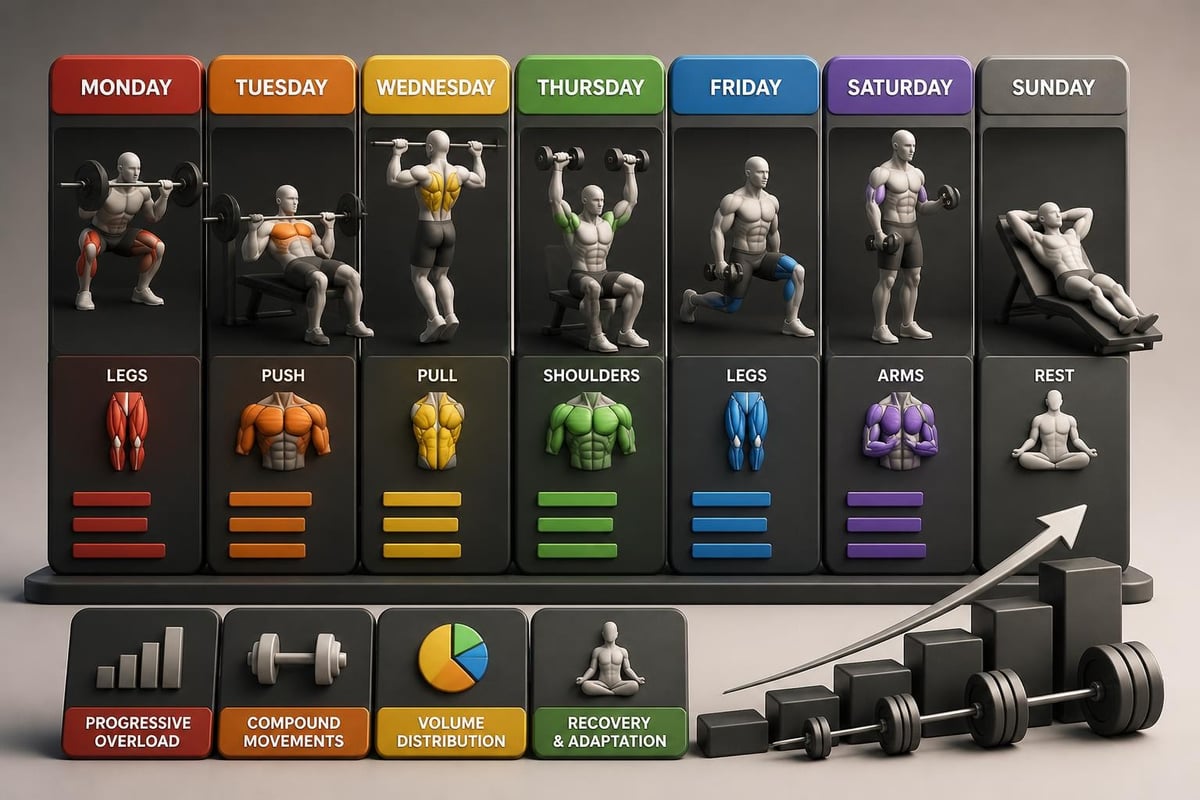
The best exercise for muscle building delivers results only when programmed with appropriate volume and frequency. Recent research suggests 10-20 sets per muscle group per week produces optimal growth, though individual responses vary based on training history and recovery capacity.
Weekly Training Splits
Organizing your training week determines how effectively you accumulate volume while managing fatigue. Several proven approaches exist:
| Split Type | Frequency Per Muscle | Best For | Example Schedule |
|---|---|---|---|
| Full Body | 3x per week | Beginners | Mon/Wed/Fri |
| Upper/Lower | 2x per week | Intermediate | Mon/Thu Upper, Tue/Fri Lower |
| Push/Pull/Legs | 2x per week | Advanced | Mon/Thu Push, Tue/Fri Pull, Wed/Sat Legs |
| Body Part Split | 1x per week | Advanced | Chest/Back/Shoulders/Arms/Legs |
Training each muscle group twice weekly allows you to distribute volume across sessions while providing adequate recovery between exposures. This frequency balances stimulus and adaptation more effectively than once-weekly approaches for most individuals.
Progressive Overload Strategies
Muscle growth requires continually increasing the training stimulus. Progressive overload extends beyond simply adding weight to the bar.
Methods to progress your training:
- Increase load by 2.5-5% when you can complete all prescribed reps
- Add repetitions within a given rep range before increasing weight
- Perform additional sets for priority muscle groups
- Decrease rest periods to increase metabolic stress
- Improve exercise technique to enhance muscle activation
- Increase training frequency for lagging body parts
The strength and muscle workout principles emphasize systematic progression tailored to your current capacity and goals.
Exercise Tempo and Muscle Tension
Time under tension significantly impacts hypertrophy outcomes. The eccentric (lowering) phase creates substantial muscle damage and mechanical tension. Controlling this portion of each repetition for 2-4 seconds maximizes growth stimulus while improving movement quality.
Optimal Rep Ranges for Growth
Different rep ranges stimulate muscle growth through varying mechanisms:
- 1-5 reps - Builds maximum strength and neurological efficiency
- 6-12 reps - Creates optimal balance of tension and metabolic stress
- 12-20 reps - Generates significant metabolic stress and muscle endurance
- 20+ reps - Develops muscular endurance with minimal hypertrophy
The 6-12 rep range typically produces the best muscle-building results because it allows sufficient load for mechanical tension while accumulating enough volume for metabolic stress. However, incorporating all ranges across your training week creates comprehensive development.
Nutrition and Recovery Considerations
Exercise selection matters, but nutrition fuels the growth process. Without adequate protein intake and caloric surplus, even the best exercise for muscle building fails to produce significant hypertrophy.
Protein Requirements and Timing
The ISSN position on protein and exercise recommends consuming 1.6-2.2 grams of protein per kilogram of body weight daily for muscle building. Distributing this intake across 4-6 meals optimizes muscle protein synthesis.
Peri-workout protein timing research suggests consuming protein within 2-3 hours before and after training may enhance adaptations, though total daily intake remains more important than precise timing.
Protein distribution example for a 180-pound individual:
- Breakfast: 35g protein
- Mid-morning: 25g protein
- Lunch: 40g protein
- Pre-workout: 30g protein
- Post-workout: 35g protein
- Dinner: 40g protein
This approach delivers approximately 205g daily protein spread across six feeding opportunities, supporting continuous muscle protein synthesis elevation.
Recovery Equipment and Modalities
Recovery determines how quickly you can return to productive training. The recovery and muscle care essentials accelerate repair processes between sessions. Foam rolling, percussion therapy, and proper sleep hygiene all contribute to faster recovery and better adaptations.
Quality sleep remains the most critical recovery factor. During deep sleep stages, growth hormone secretion peaks and muscle protein synthesis accelerates. Aim for 7-9 hours nightly to optimize your body's repair processes. Understanding why recovery matters as much as your workout helps you prioritize this essential component.

Advanced Techniques for Breaking Plateaus
Even with consistent training, progress eventually slows. Advanced techniques temporarily increase training stress beyond normal capacity, shocking your muscles into new growth.
Intensity Amplification Methods
These approaches should be used sparingly to prevent overtraining:
- Drop Sets - Reduce weight immediately after reaching failure and continue for additional reps
- Rest-Pause Training - Take 10-15 second breaks during a set to accumulate more total reps
- Forced Repetitions - Use minimal assistance to complete 2-3 reps beyond failure
- Tempo Manipulation - Slow down eccentric or concentric phases to increase time under tension
- Cluster Sets - Take brief intra-set rest periods to maintain high load across more reps
Apply these techniques to 1-2 exercises per session maximum, focusing on your priority muscle groups. Overusing intensity techniques leads to excessive fatigue that impairs recovery.
Exercise Variation Strategy
While consistency builds results, strategic exercise rotation prevents accommodation and addresses weaknesses. Maintain core compound movements as program staples, but rotate accessory exercises every 4-6 weeks.
| Exercise Category | Frequency of Change | Purpose |
|---|---|---|
| Primary Compounds | Every 12-16 weeks | Build foundational strength |
| Secondary Compounds | Every 8-12 weeks | Target specific weaknesses |
| Isolation Movements | Every 4-6 weeks | Prevent accommodation |
| Specialty Exercises | Every 2-4 weeks | Address acute limitations |
This hierarchical approach provides stability where it matters most while introducing sufficient variety to prevent stagnation.
Common Mistakes That Limit Progress
Understanding what prevents muscle growth helps you avoid wasted effort. Many lifters unknowingly sabotage their progress through preventable errors.
Training Errors
Most frequent mistakes include:
- Ego lifting with excessive weight at the expense of proper form
- Neglecting progressive overload by using the same weights indefinitely
- Training with insufficient volume to trigger growth adaptations
- Skipping exercises that target weaker muscle groups
- Failing to track workouts and measure progress objectively
Keeping a detailed training log allows you to identify patterns and ensure consistent progression. Record exercises, weights, sets, reps, and rest periods for each session.
Equipment and Form Issues
Using appropriate equipment and maintaining proper technique prevents injury while maximizing muscle activation. Worn-out footwear compromises stability during squats and deadlifts, while poorly maintained equipment creates unnecessary injury risk. The FAQ section addresses common questions about selecting quality training gear.
Form breakdowns typically occur when fatigue accumulates or when attempting weights beyond current capacity. Video recording your sets from multiple angles reveals technical flaws invisible during execution. Focus on movement quality, especially during the final challenging reps when compensation patterns emerge.
Building a Sustainable Muscle-Growth Program
Long-term success requires balancing ambition with sustainability. The best exercise for muscle building only works when you can perform it consistently over months and years. Programs that ignore individual preferences, lifestyle constraints, or recovery capacity inevitably fail despite perfect exercise selection.
Personalization Factors
Customize your approach based on these individual variables:
- Training age - Beginners respond to almost any stimulus, while advanced lifters need greater specificity
- Recovery capacity - Age, stress, sleep quality, and nutrition affect how much volume you tolerate
- Injury history - Previous injuries may require exercise modifications or alternative movements
- Equipment access - Train with what you have available consistently rather than occasionally
- Time availability - Shorter frequent sessions often outperform infrequent extended workouts
The fitness routine principles emphasize creating sustainable habits that fit your lifestyle rather than following rigid templates that breed inconsistency.
Mobility and Injury Prevention
Maintaining adequate mobility allows you to perform exercises through full ranges of motion, maximizing muscle recruitment and growth stimulus. Restricted ankle, hip, or shoulder mobility compromises squat depth, deadlift positioning, and pressing mechanics respectively.
Dedicate 10-15 minutes daily to targeted mobility work addressing your specific limitations. The yoga, pilates, and mobility collection provides tools that enhance range of motion and movement quality. Better mobility translates directly to improved exercise execution and reduced injury risk.
Measuring and Tracking Progress
Objective progress tracking separates productive training from wasted effort. While the scale provides one data point, multiple metrics paint a complete picture of your muscle-building success.
Key Performance Indicators
Monitor these variables to assess genuine progress:
| Metric | Measurement Frequency | Significance |
|---|---|---|
| Body Weight | Weekly | Overall mass changes |
| Circumference Measurements | Bi-weekly | Muscle growth in specific areas |
| Progress Photos | Monthly | Visual appearance changes |
| Strength Levels | Every Session | Progressive overload verification |
| Body Composition | Every 4-6 weeks | Muscle vs. fat ratio changes |
Strength increases on compound movements indicate productive training when accompanied by stable or improving technique. Adding 50 pounds to your squat over six months suggests significant muscle development in your lower body.
Circumference measurements of arms, chest, thighs, and calves reveal regional growth patterns. Increases of 0.5-1.0 inches per month in target areas confirm your program effectiveness. Taking measurements at consistent times and body positions ensures reliable comparisons.
Building muscle requires selecting exercises that create maximum growth stimulus while fitting your individual circumstances and equipment access. The best exercise for muscle building combines compound movements like squats, deadlifts, and presses with appropriate volume, progressive overload, and adequate recovery. Success depends on consistent execution over time rather than perfect program design. SkyFitNet provides the training equipment, recovery tools, and mobility essentials you need to execute your muscle-building program effectively, helping you train smarter and achieve sustainable strength gains throughout your fitness journey.