

Best Exercise for Gym: Essential Movements for Results

Walking into a commercial gym can feel overwhelming, especially when faced with countless machines, free weights, and exercise options. Every fitness enthusiast wants to know which movements deliver the greatest return on their training investment. While no single exercise addresses every fitness goal, understanding which movements provide the foundation for strength, muscle growth, and functional fitness helps you build an effective workout strategy. This guide explores the most effective gym exercises, how to program them correctly, and which equipment supports your performance across different training phases.
Understanding Compound Movements as the Foundation
The best exercise for gym training typically falls into the category of compound movements. These multi-joint exercises recruit multiple muscle groups simultaneously, allowing you to move heavier loads and generate greater metabolic stress than isolation exercises. Research demonstrates that compound movements create superior hormonal responses, elevate heart rate more effectively, and build functional strength that transfers to real-world activities.
Why Compound Exercises Dominate Programming
When you perform exercises like squats, deadlifts, and bench presses, your body coordinates numerous muscles to stabilize joints while generating force. This coordination builds neuromuscular efficiency alongside raw strength. The evidence on resistance training variables for optimizing hypertrophy confirms that exercise selection significantly impacts muscle growth outcomes, with compound movements generally producing superior results compared to isolation-only programs.
Key advantages of compound movements include:
- Greater total muscle activation per exercise
- Improved intermuscular coordination
- Enhanced core stability development
- More efficient time utilization during workouts
- Superior functional carryover to daily activities
- Higher caloric expenditure per training session
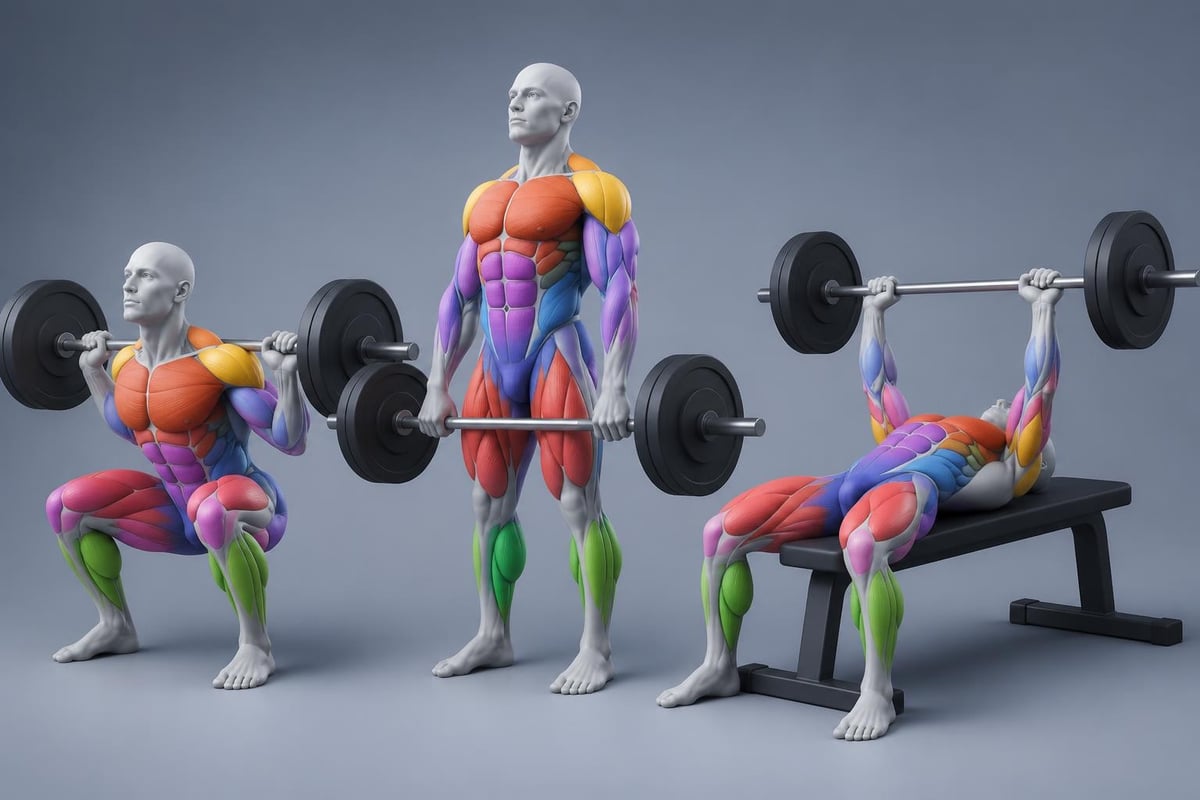
The time efficiency factor proves especially valuable for busy professionals. Rather than performing five isolation exercises to target individual muscle groups, a single compound movement addresses multiple areas simultaneously. This approach aligns perfectly with evidence-based programming principles while accommodating realistic scheduling constraints.
The Squat: Lower Body Power Development
Many strength coaches consider the barbell back squat the best exercise for gym-based lower body development. This movement pattern builds the quadriceps, glutes, hamstrings, and entire posterior chain while demanding significant core stabilization. According to Harvard Health's guidance on strength training, exercises that engage large muscle groups deliver substantial health benefits beyond aesthetic improvements.
Squat Variations for Different Goals
| Squat Type | Primary Focus | Equipment Required | Skill Level |
|---|---|---|---|
| Barbell Back Squat | Overall leg development | Barbell, rack | Intermediate |
| Front Squat | Quadriceps, core | Barbell, rack | Advanced |
| Goblet Squat | Learning movement pattern | Dumbbell or kettlebell | Beginner |
| Bulgarian Split Squat | Unilateral strength | Dumbbells, bench | Intermediate |
The movement begins with proper setup: feet positioned shoulder-width apart, bar resting across the upper trapezius, core braced for spinal protection. As you descend, maintaining an upright torso while driving knees forward and out prevents excessive forward lean. Depth should reach parallel or below when mobility permits, though individual anthropometry influences optimal positioning.
For those new to loaded squats, investing in quality home fitness and strength equipment enables consistent practice between gym sessions. Building movement proficiency requires frequent exposure to the pattern, making accessible equipment invaluable for skill development.
Deadlift Variations for Posterior Chain Strength
The deadlift ranks among the most effective exercises for developing total-body strength, particularly throughout the posterior chain. This hip-hinge movement builds the glutes, hamstrings, erector spinae, lats, and grip strength simultaneously. Few exercises match its practical application, as the deadlift directly mimics the mechanics of lifting objects from the ground.
Programming Deadlifts Effectively
Three primary deadlift variations serve different purposes:
- Conventional Deadlift – Feet hip-width apart, hands outside legs, emphasizes hamstrings and lower back
- Sumo Deadlift – Wide stance, hands inside legs, shifts emphasis toward adductors and quadriceps
- Romanian Deadlift – Performed from standing position, isolates hamstrings and glutes with minimal knee bend
Technical execution determines safety and effectiveness. The lift initiates by creating full-body tension: gripping the bar firmly, pulling slack from the bar, bracing the core, and maintaining neutral spine alignment. As you drive through the floor with your legs, the bar travels in a vertical path close to the shins and thighs. Lockout occurs through simultaneous hip extension and thoracic extension, not hyperextension of the lumbar spine.
Progressive overload remains critical for continued adaptation. Begin with weights allowing perfect form across all repetitions, then gradually increase load as technique solidifies. Many training programs incorporate deadlifts once or twice weekly, providing adequate recovery between demanding sessions.
Horizontal and Vertical Pressing Movements
Upper body pressing exercises develop the chest, shoulders, and triceps while building functional pushing strength. The best exercise for gym-based pressing depends on your specific goals, but both horizontal and vertical variations deserve programming consideration.
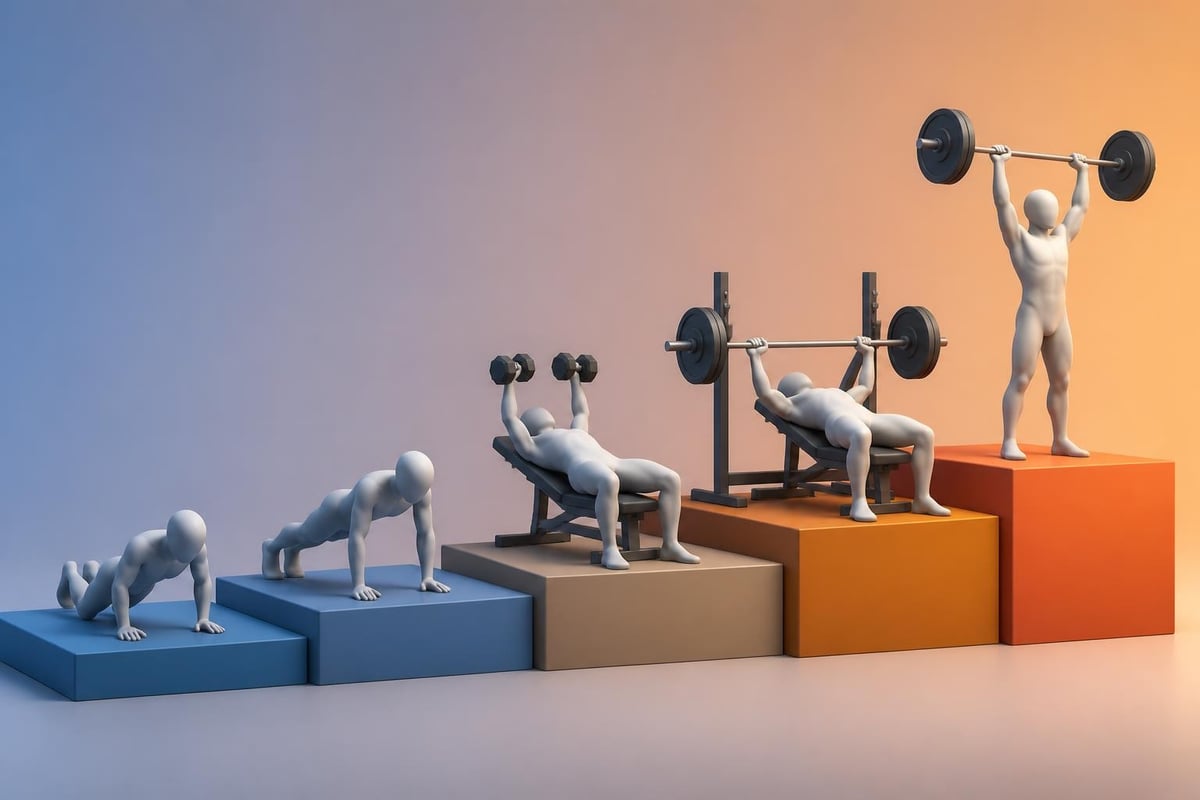
The barbell bench press remains the standard horizontal pressing movement. Lying supine on a bench, you lower a loaded barbell to the chest before pressing it back to full arm extension. This exercise builds the pectoralis major, anterior deltoids, and triceps brachii. Proper technique requires retracting the scapulae, maintaining five points of contact with the bench and floor, and controlling the eccentric phase.
Pressing Exercise Selection Matrix
Horizontal Pressing Options:
- Barbell Bench Press (flat, incline, decline angles)
- Dumbbell Bench Press (greater range of motion, unilateral demand)
- Push-Ups (bodyweight foundation, endless variations)
Vertical Pressing Options:
- Barbell Overhead Press (standing or seated)
- Dumbbell Shoulder Press (improved shoulder health)
- Landmine Press (reduced shoulder stress)
The standing overhead press challenges whole-body stability while building shoulder strength and size. Starting with the barbell at shoulder height, you press the weight directly overhead while maintaining a neutral spine. This movement requires significant core engagement to prevent excessive lumbar extension, making it valuable beyond pure shoulder development.
Pulling Exercises for Back Development and Balance
Balanced programming pairs pressing movements with equivalent pulling volume. The best exercise for gym training includes both horizontal and vertical pulling patterns to develop the latissimus dorsi, rhomboids, trapezius, and biceps while preventing postural imbalances common among desk workers.
Pull-ups and chin-ups represent the gold standard for vertical pulling. These bodyweight exercises build impressive back width and arm strength. Beginners can utilize resistance bands for assistance or perform negative repetitions (controlling the descent only) to build the necessary strength. The comparison between split versus full-body training routines suggests that exercise frequency matters less than total weekly volume, allowing flexibility in programming pull-up variations.
Effective pulling exercise categories include:
- Vertical Pulls: Pull-ups, chin-ups, lat pulldowns
- Horizontal Pulls: Barbell rows, dumbbell rows, cable rows, inverted rows
- Isolation Pulls: Face pulls, straight-arm pulldowns
Barbell bent-over rows deserve special attention as a compound horizontal pull. With a hip-hinge position similar to the deadlift, you pull a barbell toward your lower chest or upper abdomen. This movement strengthens the entire back while reinforcing proper hip-hinge mechanics under load.
Core Training Beyond Crunches
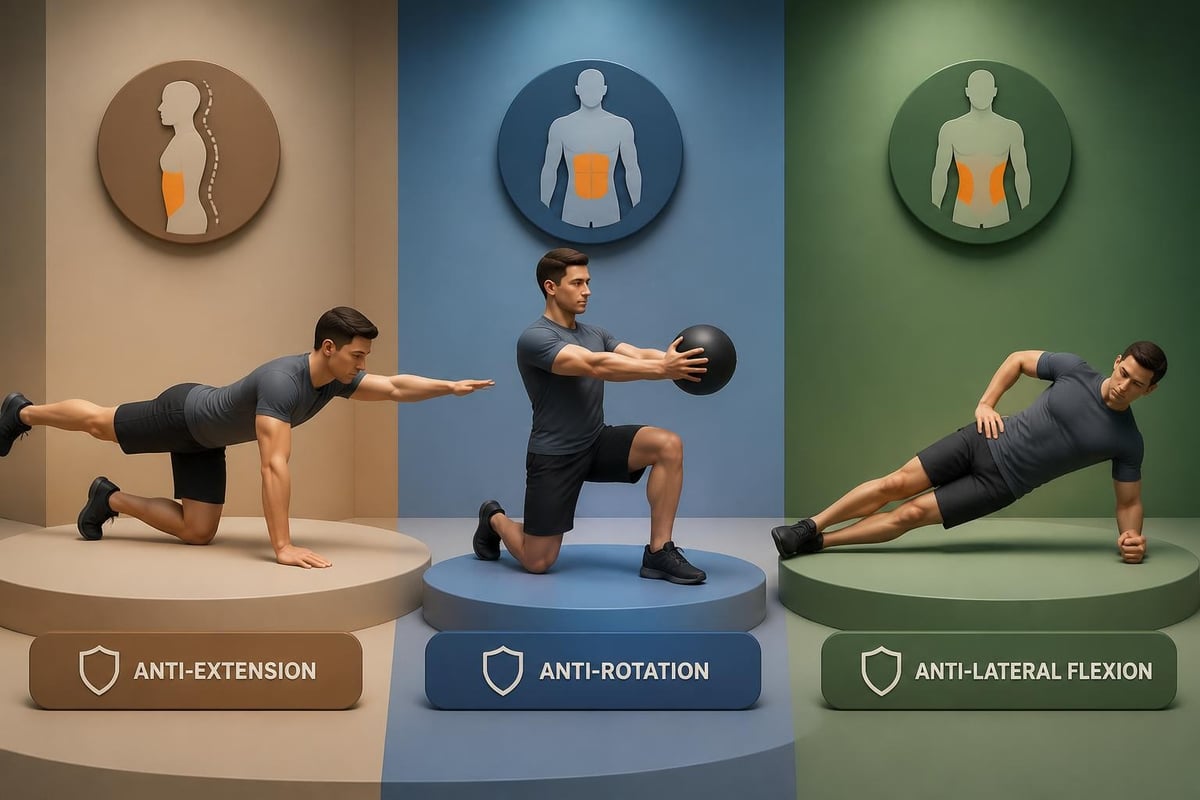
Traditional abdominal exercises like crunches have limited carryover to functional strength and athletic performance. The best exercise for gym-based core development emphasizes anti-movement patterns: resisting unwanted motion rather than creating it. This approach builds genuine core stability that protects the spine during heavy compound lifts and daily activities.
Anti-Movement Core Exercise Categories
| Pattern Type | Function | Example Exercises |
|---|---|---|
| Anti-Extension | Prevents lumbar hyperextension | Planks, ab wheel rollouts, dead bugs |
| Anti-Rotation | Resists rotational forces | Pallof presses, one-arm carries |
| Anti-Lateral Flexion | Prevents side bending | Side planks, suitcase carries |
| Anti-Flexion | Maintains spinal extension | Back extensions, bird dogs |
Loaded carries represent particularly effective core training. Simply walking while holding heavy weights in various positions (farmer's carries, waiter walks, suitcase carries) forces the core musculature to stabilize the spine against asymmetric loads. These exercises build functional strength with direct carryover to real-world demands.
The plank family of exercises provides scalable core training for all fitness levels. Beginning with basic front planks, you can progress to more challenging variations including single-leg planks, plank-to-push-up transitions, and weighted planks. Maintaining perfect alignment throughout the duration builds true core endurance.
Programming Considerations and Training Splits
Exercise selection represents only one variable in effective program design. The American College of Sports Medicine guidelines provide evidence-based recommendations for frequency, intensity, volume, and progression that optimize results while managing injury risk.
Fundamental programming principles include:
- Progressive Overload – Systematically increasing training stress over time through added weight, repetitions, or training density
- Specificity – Matching exercise selection and parameters to your primary goals
- Variation – Periodically adjusting exercises, loading schemes, and training splits to prevent adaptation plateaus
- Recovery – Allowing adequate rest between sessions targeting the same muscle groups
Most intermediate lifters benefit from training each major movement pattern twice weekly. This frequency provides sufficient stimulus for adaptation while allowing proper recovery. Whether you choose a full-body split, upper/lower split, or push/pull/legs arrangement matters less than consistent execution and progressive overload.
For those balancing gym training with active lifestyles, having proper recovery and muscle care tools supports adaptation between sessions. Recovery quality directly impacts your ability to train intensely and frequently without accumulating excessive fatigue.
Accessory Exercises and Weak Point Development
While compound movements form the foundation, targeted accessory work addresses specific weaknesses and imbalances. The best exercise for gym programming includes strategic isolation movements that support compound lift performance or develop lagging muscle groups.
Common accessory exercise applications:
- Bicep curls and tricep extensions for arm development
- Lateral raises for shoulder width and health
- Leg curls and extensions for knee integrity
- Calf raises for lower leg strength
- Face pulls for rear deltoid and upper back development
These movements typically utilize higher repetition ranges (8-15+ reps) with moderate loads, emphasizing muscle contraction quality over absolute strength. Programming accessories at the end of workouts after completing primary compound movements ensures you address fundamental strength development first.
Individual biomechanics and injury history influence accessory selection. Someone with a history of shoulder issues might prioritize rotator cuff strengthening exercises, while a lifter struggling with squat depth benefits from targeted ankle mobility work and hip flexor strengthening.
Exercise Execution and Form Refinement
Technical proficiency separates productive training from injury risk. The best exercise for gym results becomes worthless when performed with poor mechanics. Investing time in form refinement early in your training career pays dividends through safer, more effective workouts over the long term.
Key technical elements across major exercises:
- Breathing Mechanics: Inhale during eccentric phases, exhale during concentric phases, or utilize breath holds for maximal lifts
- Spinal Alignment: Maintain neutral spine positions appropriate to each exercise
- Range of Motion: Move through the fullest range your mobility safely allows
- Tempo Control: Control both lifting and lowering phases rather than relying on momentum
- Setup Consistency: Establish identical positioning for each repetition
Video analysis provides valuable feedback for form assessment. Recording sets from multiple angles reveals technique flaws invisible during execution. Many lifters discover their perceived movement patterns differ significantly from actual mechanics.
Working with qualified coaches or trainers accelerates skill development, particularly for complex barbell movements. Even experienced lifters benefit from periodic form checks, as technique gradually degrades without conscious attention. The World Health Organization's physical activity guidance emphasizes proper technique for maximizing health benefits while minimizing injury risk.
Equipment Selection and Training Tools
The best exercise for gym training often requires specific equipment for optimal execution. While basic barbell movements deliver outstanding results, strategic equipment choices enhance exercise variety, address mobility limitations, and accommodate individual preferences.
Essential Equipment Categories
| Equipment Type | Primary Uses | Training Benefits |
|---|---|---|
| Barbells | Squats, deadlifts, presses, rows | Heavy loading, bilateral strength |
| Dumbbells | Presses, rows, accessory work | Unilateral training, stability demands |
| Kettlebells | Swings, carries, complexes | Explosive power, conditioning |
| Resistance Bands | Warm-ups, accommodating resistance | Variable tension, joint-friendly |
| Cable Machines | Isolation exercises, constant tension | Precise loading, multiple angles |
Quality yoga and pilates mobility tools complement strength training by addressing flexibility limitations that restrict exercise range of motion. Many lifters discover that improving hip and ankle mobility through dedicated work significantly enhances squat depth and overall movement quality.
Resistance bands deserve special mention for their versatility. Beyond warm-up applications, bands provide accommodating resistance that increases tension throughout the range of motion. This loading characteristic complements traditional free weight training, which typically presents maximum difficulty at specific joint angles.
Cardiovascular Integration with Strength Training
While this discussion emphasizes resistance training, complete fitness programming includes cardiovascular conditioning. The best exercise for gym-based conditioning depends on your strength training focus, recovery capacity, and specific goals.
Low-impact conditioning options include:
- Rowing machine intervals
- Assault bike sprints
- Incline treadmill walking
- Swimming or aqua jogging
- Elliptical training
High-intensity interval training (HIIT) provides time-efficient cardiovascular adaptation but requires careful programming to avoid interfering with strength development. Most intermediate lifters benefit from separating intense conditioning and heavy strength work by at least several hours, allowing partial recovery between sessions.
Steady-state cardio performed at conversational pace supports recovery between demanding strength sessions. This "active recovery" approach promotes blood flow without creating significant additional fatigue. Many lifters incorporate 20-30 minute walks on rest days or following strength workouts.
For those incorporating running into their fitness regimen, specialized running and active lifestyle gear protects joints and enhances performance across various cardio modalities.
Hydration and Workout Essentials
Performance during any exercise relies heavily on proper hydration status. Even mild dehydration impairs strength output, reduces endurance capacity, and compromises cognitive function during complex movements. Maintaining optimal hydration requires consistent fluid intake before, during, and after training sessions.
Hydration guidelines for gym training:
- Consume 16-20 ounces of water 2-3 hours before training
- Drink 8-10 ounces 15-20 minutes before your workout begins
- Sip 7-10 ounces every 10-20 minutes during exercise
- Replace 150% of fluid lost through sweat post-workout
Having reliable hydration and workout essentials ensures you maintain proper fluid intake throughout demanding training sessions. Electrolyte supplementation becomes important during particularly long or intense workouts when mineral losses through sweat become significant.
Beyond hydration, practical workout accessories like lifting belts, knee sleeves, and wrist wraps support performance during heavy compound movements. These tools should supplement proper technique rather than compensate for technical deficiencies.
Tracking Progress and Making Adjustments
The best exercise for gym training produces measurable improvements over time. Systematic progress tracking reveals which exercises and programming approaches deliver results for your individual physiology and training circumstances.
Key metrics worth monitoring:
- Absolute Strength: Maximum weight lifted for primary compound movements
- Repetition Strength: Weight used for standard repetition ranges (5 reps, 10 reps, etc.)
- Body Composition: Measurements, photos, or scanning technologies
- Performance Markers: Repetitions to failure at submaximal loads, bar velocity, recovery heart rate
- Subjective Measures: Energy levels, sleep quality, motivation, workout enjoyment
Digital training logs simplify data collection and analysis. Recording exercise selection, loading parameters, repetitions completed, and subjective difficulty ratings creates a comprehensive training history. This information guides intelligent programming adjustments when progress stalls.
Expect strength gains to slow as training age increases. Beginners often add weight to major lifts weekly, while advanced lifters celebrate monthly personal records. Understanding realistic progression timelines prevents frustration and supports long-term adherence.
Individual Variation and Program Customization
No universally optimal exercise prescription exists. The best exercise for gym training varies based on training history, injury status, biomechanical factors, available equipment, time constraints, and personal preferences. Effective programming balances evidence-based principles with individual customization.
Someone with long femurs relative to torso length might find conventional deadlifts awkward while thriving with sumo variations. Another lifter with shoulder mobility restrictions may substitute dumbbell presses for barbell bench pressing. These adjustments represent intelligent programming rather than weakness or deviation from optimal approaches.
Factors influencing exercise selection:
- Limb length proportions and anthropometry
- Previous injuries and current pain or limitations
- Sport-specific demands for athletic populations
- Available training time per session and week
- Exercise enjoyment and adherence likelihood
- Access to specific equipment
Experimenting with various exercises and training approaches helps identify what works best for your circumstances. While evidence-based guidelines provide valuable starting points, individual response variability means some personal experimentation proves necessary. For comprehensive equipment options supporting diverse training approaches, explore the full shop all collection featuring versatile training tools.
Building an effective gym training program centers on selecting compound movements that address multiple muscle groups, programming adequate volume and intensity for continued adaptation, and executing exercises with proper technique. The squat, deadlift, pressing variations, and pulling movements form the foundation of results-driven programming, complemented by strategic accessory work and appropriate conditioning. Whether you train at a commercial facility or develop your home gym, having quality equipment that supports proper form and progressive overload proves essential. SkyFitNet provides the training, recovery, and mobility essentials you need to execute your programming effectively, support adaptation between sessions, and build the strength and physique you're working toward.